Best Practices for Ensuring Compliance in Employee Crypto Trading

The adoption of cryptocurrencies like Bitcoin, Ethereum, and other digital assets has skyrocketed in recent years, fundamentally reshaping financial markets. Employees in the finance sector are increasingly engaging in crypto trading, a trend that shows no signs of slowing down.
This rising participation in crypto markets presents significant compliance challenges for financial firms. Global regulators, including the SEC and International Organization of Securities Commissions (IOSCO), classify crypto trading as a high-risk area that requires enhanced oversight. Without proper monitoring, firms expose themselves to:
- Insider trading and market manipulation: Employees with material nonpublic information (MNPI) could exploit crypto’s volatility for personal gain.
- Conflicts of interest: Employees trading crypto in personal accounts may create ethical and financial conflicts within their organizations.
- Regulatory and reputational risks: Lack of oversight could lead to fines, internal fraud, and reputational damage.
- Compliance gaps: Traditional monitoring tools often lack crypto-tracking capabilities, making it critical for firms to adopt specialized compliance solutions.
As crypto adoption continues to grow, firms must take proactive steps to ensure compliance in employee trading. In this blog post, we’ll outline best practices to help firms navigate the evolving regulatory landscape and implement effective crypto trading oversight.
Why Employee Crypto Trade Monitoring Matters and Common Risks
First, let’s expand a little on the risks of unchecked crypto trading.
One of the biggest risks posed is insider trading. Employees with access to MNPI—such as pending mergers, earnings reports, or regulatory decisions—could exploit crypto’s volatility for personal gain. Given the speed and anonymity of crypto transactions, detecting and preventing illicit trades is highly challenging.
Conflicts of interest are another concern. Employees working in roles that influence financial markets—including investment managers, analysts, and traders—may make crypto investments that conflict with their professional responsibilities. Similarly, those in technology and fintech sectors could have early access to product launches or strategic developments that impact token values.
Money laundering risks add another layer of complexity. Many cryptocurrencies allow for pseudonymous transactions, making it harder to trace the flow of funds. Regulators have flagged crypto as a high-risk area for illicit finance, meaning firms must implement anti-money laundering (AML) measures to track digital asset transactions and detect suspicious activity.
Failure to monitor crypto trading can result in reputational damage and regulatory penalties. Firms that ignore compliance gaps may face fines, legal action, and loss of investor confidence—especially as regulators worldwide strengthen enforcement measures.
While crypto trading oversight is relevant across many sectors, certain industries face heightened risk:
- Financial services (banks, hedge funds, asset managers) must comply with strict SEC, FINRA, and other global regulatory requirements, making crypto trade monitoring essential.
- Technology companies, particularly in blockchain, fintech, and payments, employ workers with early access to digital asset innovations and market-moving developments.
- Consulting and advisory firms manage sensitive client information, including corporate strategy and financial planning, which, if misused, could influence crypto prices.
Regulators worldwide are stepping up enforcement on employee crypto trading. The SEC and FINRA require firms to monitor employees’ private securities transactions, including digital assets, while AML laws mandate tracking crypto transactions to prevent fraud and illicit activity. Meanwhile, global regulatory bodies like IOSCO and the European Parliament are increasing their scrutiny on digital asset trading, signaling that compliance expectations will only grow more stringent.
Beyond regulatory risks, employee crypto trading can lead to operational and security concerns:
- Unmonitored trading during work hours can result in productivity losses and misuse of company resources.
- Employees using corporate accounts or networks for crypto transactions create legal and cybersecurity liabilities.
- The lack of integration between crypto monitoring and existing compliance tools makes it harder to detect risks across traditional and digital asset trading.
At the same time, compliance teams must balance oversight with employee privacy. Employees trading on personal wallets or decentralized exchanges may push back against overly invasive monitoring. To maintain trust, firms should implement clear policies that outline:
- Which crypto transactions require disclosure
- How employee data is tracked and protected
- What monitoring tools will be used
Firms that take a proactive approach to crypto trade monitoring can safeguard market integrity and stay agile in the face of evolving regulatory challenges.
Best Practices for Employee Crypto Trade Compliance
Implementing stringent compliance practices not only helps prevent insider trading and conflicts of interest but also protects the firm from legal and reputational risks.
Establish Clear Policies
A strong crypto trading compliance policy is the foundation of an effective oversight program. Firms should clearly define acceptable and unacceptable behaviors related to personal crypto trading, including:
- Pre-clearance requirements for crypto trades
- Restricted trading periods for employees with access to MNPI
- Disclosure obligations for holdings in digital assets
Employees must also understand the consequences of non-compliance—whether it’s disciplinary action, financial penalties, or even termination. Policies should be aligned with existing regulations and regularly updated to reflect industry best practices and regulatory changes.
Leverage Advanced Monitoring Tools
Traditional trade surveillance tools often cannot track crypto transactions across decentralized exchanges and private wallets. Firms should look for a modern employee trade management platform that can do all of the following:
- Monitor crypto transactions across multiple exchanges and wallets
- Trigger real-time alerts for suspicious trading activity
- Automate reporting and flag potential policy violations
- Integrate with existing compliance systems for seamless oversight
This type of advanced monitoring technology can effectively detect and mitigate compliance risks while reducing the manual workload on compliance teams.
Conduct Regular Training and Education
Employees must be educated on the compliance risks associated with crypto trading, including insider trading violations, conflicts of interest, and AML concerns. Regular training sessions and attestations ensure employees stay informed about evolving crypto regulations and understand their compliance responsibilities. A well-informed workforce reduces the likelihood of inadvertent violations and fosters a culture of compliance.
Maintain Transparent Communication
Compliance should be a collaborative effort, not a punitive process. Firms should engage employees in open discussions about crypto trading rules and how they protect both the organization and its employees. Transparency builds trust and accountability, especially when addressing privacy concerns related to monitoring.
Policies should clearly outline:
- Which crypto transactions are subject to monitoring
- How employee data is used and protected
- Why compliance measures benefit both the firm and employees
By being communicative and supportive, firms can encourage active participation in compliance efforts rather than resistance.
Document and Audit Everything
Comprehensive recordkeeping and audits ensure firms can demonstrate regulatory compliance and identify areas for improvement:
- Maintain detailed records of employee crypto trades, pre-clearance requests, and compliance approvals
- Conduct regular audits to assess policy effectiveness and uncover compliance gaps
- Use audit findings to refine monitoring strategies and enhance regulatory preparedness
To successfully implement these best practices, firms need the right technology to monitor, track, and enforce compliance policies in real time. Advanced compliance tools can bridge the gap between regulatory requirements and practical oversight, ensuring firms stay ahead of emerging risks in employee crypto trading.
Tools and Technologies for Crypto Trade Monitoring
Crypto compliance platforms provide real-time visibility into employee trading activities, ensuring adherence to company policies and regulatory requirements while automating compliance checks to reduce manual workloads.
To effectively mitigate risks and maintain compliance, firms should seek platforms with robust monitoring capabilities, including:
- Employee trade management – Oversee employee transactions across both traditional securities and cryptocurrencies, ensuring consistent compliance enforcement.
- MNPI monitoring – Detect and prevent insider trading by ensuring employees do not trade based on MNPI.
- Comprehensive supervision – Integrate crypto oversight with existing securities monitoring.
- Real-time alerts and reporting – Identify suspicious activities instantly and generate compliance reports to support regulatory audits.
- Automated pre-clearance – Require employees to seek approval before executing trades, reducing the risk of policy violations.
- Multi-exchange and wallet tracking – Capture transaction data from multiple crypto exchanges and decentralized wallets.
For firms managing both securities and crypto trading compliance, integrating a crypto monitoring solution with existing compliance platforms is essential. A unified compliance framework:
- Ensures seamless oversight by tracking all employee trading activity in one system, reducing the risk of compliance blind spots.
- Reduces operational silos by leveraging existing workflows rather than creating separate, fragmented processes.
- Strengthens regulatory compliance by providing a single source of truth for all employee trading activity, simplifying audits and reporting.
With StarCompliance’s Crypto Trading Compliance solution, firms can automate oversight, enforce trading restrictions, and seamlessly integrate crypto monitoring with existing compliance workflows.
Ready to enhance your crypto compliance strategy? Book a demo today to see how StarCompliance can help you stay compliant, reduce risk, and protect your firm’s reputation.
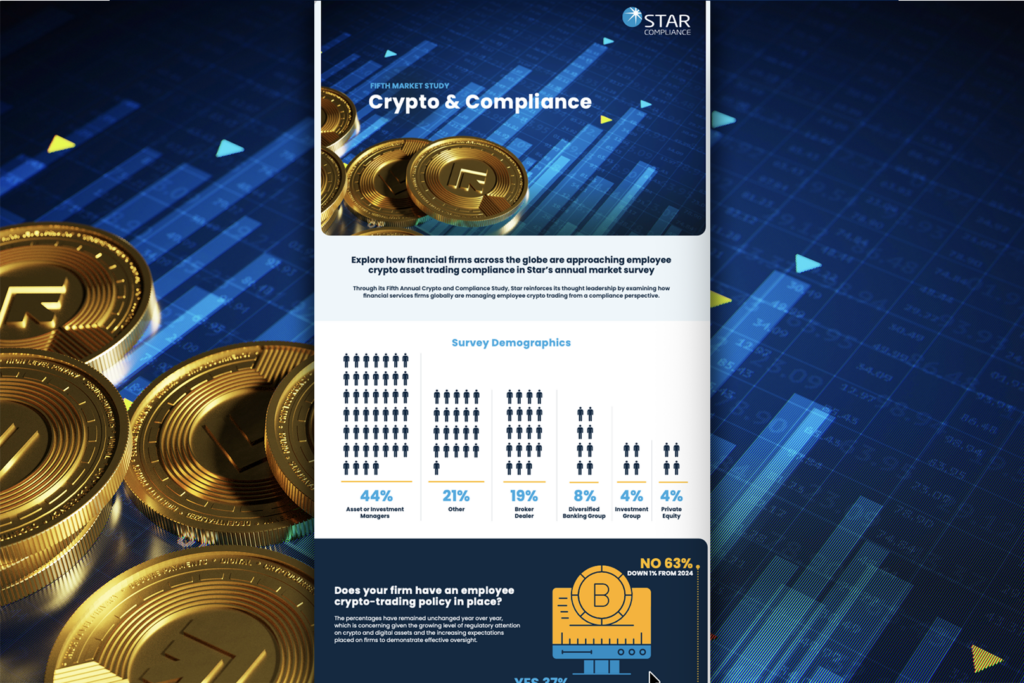
Fifth Annual Crypto & Compliance Study
Frequently Asked Questions
Is monitoring employee trades a violation of privacy?
No, monitoring employee trading is not a privacy violation when conducted in compliance with industry regulations and company policies. Financial firms are legally required to track and report employee securities transactions, including crypto, to prevent insider trading, conflicts of interest, and financial misconduct. However, firms should implement transparent policies that outline what data is monitored, how it is used, employees’ rights, and data protection measures. This ensures compliance efforts are clear, fair, and aligned with privacy laws while maintaining regulatory integrity.
What regulations apply to employee crypto trading?
Several global regulations impact employee cryptocurrency trading, including:
- SEC and FINRA (U.S.) – Require firms to monitor employee trading in private securities, including digital assets, to prevent insider trading.
- Anti-money laundering (AML) and Know Your Customer (KYC) Laws – Mandate tracking and reporting of crypto transactions to combat money laundering and financial crime.
- IOSCO and European Parliament (Global) – Increasing regulatory scrutiny on crypto trading compliance, particularly for financial professionals.
Regulatory bodies worldwide are evolving their stance on digital asset oversight, making it crucial for firms to stay ahead of compliance requirements.
How can firms ensure employee crypto trade compliance?
Firms can ensure compliance with crypto trading regulations by following these best practices:
1. Establish Clear Policies
- Define acceptable and unacceptable crypto trading behaviors.
- Set pre-clearance requirements and blackout periods for employees with MNPI.
- Align policies with regulatory standards (SEC, FINRA, AML laws).
2. Use Advanced Monitoring Tools
- Track employee crypto trades across multiple exchanges and wallets.
- Automate pre-clearance approvals and compliance reporting.
- Enable real-time alerts for suspicious trading activity.
3. Conduct Regular Training & Education
- Educate employees on insider trading risks, conflicts of interest, and AML rules.
- Provide ongoing updates on evolving crypto regulations.
- Offer interactive training and assessments to reinforce compliance awareness.
4. Maintain Transparent Communication
- Clearly explain why monitoring is necessary and how data is used.
- Address privacy concerns and ensure compliance with data protection laws.
- Foster a culture of trust and accountability within the organization.
5. Integrate Crypto Monitoring with Existing Compliance Systems
- Ensure a unified approach to tracking both securities and crypto trades.
- Reduce operational silos by integrating with current compliance workflows.
- Strengthen audit readiness with a centralized compliance platform.
6. Document and Audit Everything
- Maintain detailed records of employee trades, pre-clearance requests, and approvals.
- Conduct regular audits to identify compliance gaps and improve oversight.
- Use audit insights to refine policies and enhance regulatory preparedness.
Is there software available to help monitor employee crypto trading?
Yes! Crypto compliance platforms like StarCompliance’s Crypto Trading Compliance solution provide:
- Real-time monitoring of employee crypto trades
- Automated pre-clearance for crypto transactions
- Integration with existing compliance systems
- Surveillance tools to detect insider trading and suspicious activities
These solutions help firms stay compliant, reduce risk, and streamline oversight in an ever-changing regulatory environment.