
From Policy to Practice: Rethinking Insider Trading Compliance for Digital Markets
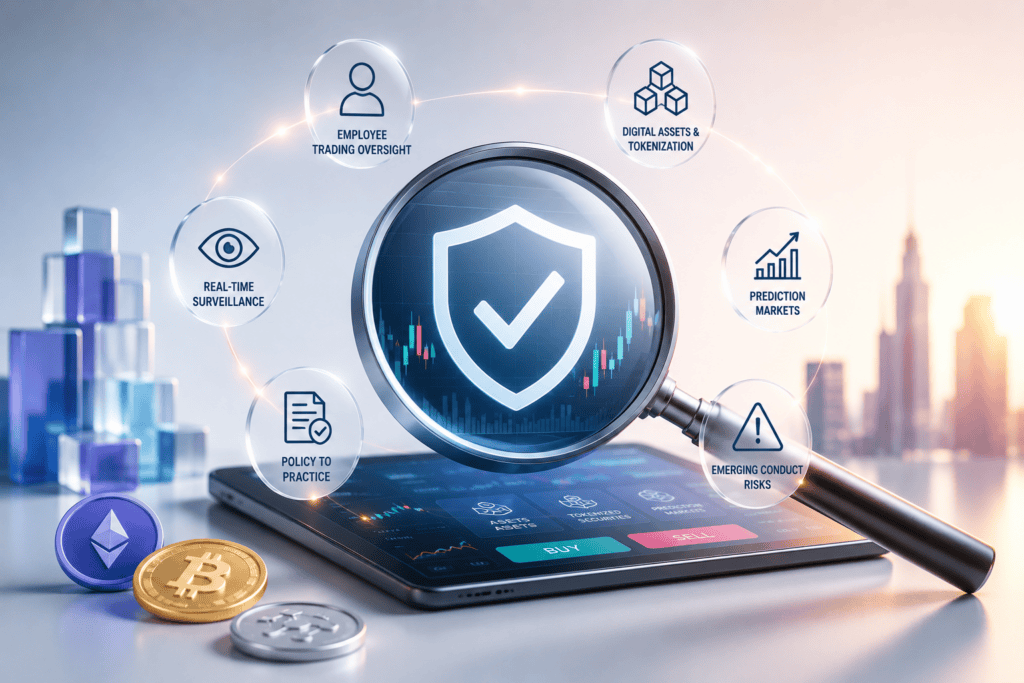
How compliance teams can modernize employee trading oversight for digital assets, tokenization, prediction markets, and emerging conduct risks.
NOTE: This is the final installment of our four-part series exploring insider trading and employee compliance in digital markets. Throughout the series, we’ve examined the evolving regulatory landscape, the emergence of shadow trading, and the legal theories regulators can apply as trading expands beyond traditional securities.
Now, we turn to what it all means in practice and how compliance teams can prepare for what comes next.
Financial markets are changing quickly, but one thing has remained remarkably consistent throughout this series: the fundamental principles of insider trading have not changed with them.
One principle should remain at the center of every employee compliance program: MNPI is asset agnostic. Confidential information does not become less sensitive because an employee uses it to trade a digital asset, tokenized instrument, or prediction market contract rather than a traditional security. Firms must still protect MNPI, manage conflicts of interest, and prevent employees from using privileged information for personal gain. The asset may change, but the underlying conduct risk does not.
What has changed is the number of ways that information can potentially be monetized.
An employee may now gain economic exposure through traditional securities, digital assets, tokenized real-world assets, prediction markets, or economically connected instruments. Trading can occur across brokerage accounts, exchanges, digital wallets, and other platforms, sometimes operating around the clock and across multiple jurisdictions.
For compliance teams, that creates an important question: Are employee compliance programs evolving as quickly as the markets they are expected to oversee?
Expand the Definition of Employee Trading
For decades, employee trading programs have been built around traditional securities and brokerage accounts. That foundation remains important, but it may no longer capture the full scope of employee activity.
Digital assets, tokenized assets, and prediction markets are creating new ways for employees to gain economic exposure. Firms should consider whether their policies clearly define which assets, accounts, platforms, and activities employees must disclose or pre-clear.
This does not mean treating every new asset identically. Different instruments create different levels and types of risk. The objective should be to establish a framework flexible enough to assess emerging markets as they develop rather than rewriting policies every time a new product gains traction.
Look Beyond the Restricted List
Traditional restricted lists remain a fundamental compliance control, but emerging markets are challenging the assumption that insider trading risk stops with the issuer.
Emerging markets create new ways employees can act on confidential information beyond the security directly associated with it. For example:
- Shadow Trading: An employee with confidential information about one company could potentially seek to profit by trading another economically related company or asset.
- Digital Assets: Tokens, protocols, and tokenized assets can have economic relationships that do not fit neatly within traditional issuer classifications, expanding the potential reach of MNPI.
- Prediction Markets: An employee may never trade the company’s security but could potentially take a position on an event influenced by confidential information they possess.
These scenarios reinforce why firms increasingly need to understand not only what employees are trading, but how those assets and markets may be connected to the information they possess.
For compliance teams, understanding relationships between information and assets is becoming increasingly important alongside understanding the individual trade itself.
Close the Visibility Gap
Employee activity that once primarily occurred through traditional brokerage accounts can now take place across multiple venues. Digital asset exchanges, blockchain wallets, decentralized platforms, and prediction markets can create potential blind spots if firms rely exclusively on traditional monitoring approaches.
That fragmentation makes visibility increasingly important. Compliance teams need to understand where employees may be trading, what activity falls within firm policies, and whether existing monitoring capabilities provide sufficient oversight.
Without that visibility, even well-designed policies can become difficult to enforce consistently.
Add Context to Surveillance
The next evolution of employee surveillance is not simply collecting more transactions. It is creating better context around them.
Consider the difference between knowing that an employee made a trade and understanding that the employee made that trade shortly after gaining access to sensitive information about an economically related company or event.
Bringing together employee trading activity with relevant compliance data can help teams identify patterns and relationships that may otherwise be difficult to see. Timing, information access, conflicts of interest, asset relationships, and trading behavior can all provide important context when assessing potential risk.
The goal is not more alerts. It is better-informed alerts and better-informed decisions.
Build for the Risk You Haven’t Seen Yet
The biggest lesson from the rapid development of digital markets is that compliance teams cannot predict every new asset, platform, or trading model that will emerge.
A few years ago, many employee compliance programs were not contemplating tokenized real-world assets or the rapid growth of regulated prediction markets. The next innovation may create an entirely different set of challenges. That makes adaptability essential.
Rather than designing controls around individual technologies, firms should consider whether their employee compliance infrastructure can accommodate new asset classes, data sources, policies, and surveillance requirements as they emerge.
The objective should not be to predict the next market. It should be to ensure the compliance program can respond when that market arrives.
Connecting the Compliance Picture
Across this series, one theme has consistently emerged: insider trading risk is becoming increasingly interconnected.
Information can move across organizations. Employees can trade across asset classes. Economic relationships can extend beyond individual issuers. Activity can also occur across multiple markets and platforms.
At StarCompliance (Star), we believe this requires a more connected approach to employee compliance. Bringing together employee trading, digital assets, prediction markets, policies, surveillance, and relevant compliance data gives teams greater context to identify emerging risks and make more informed, defensible decisions.
Technology alone will not eliminate insider trading risk. But better visibility, stronger data, and more adaptable controls can help compliance professionals respond as markets evolve.
Looking Ahead
Throughout this series, we’ve explored how established insider trading principles are being tested by a new generation of markets. From digital assets and tokenization to shadow trading and prediction markets, each development presents its own compliance challenges.
But the larger lesson is simple: New markets do not eliminate old risks. They create new ways for those risks to emerge.
For compliance teams, the answer is not to build a new program for every new asset class. It is to develop an employee compliance framework that can evolve alongside innovation while maintaining the fundamental principles of transparency, accountability, and market integrity.
Markets will continue to innovate, and new ways to trade will continue to emerge. The challenge for compliance teams is not predicting every new asset or platform. It is building an employee compliance program capable of adapting when they do.
To learn more about how Star can help your organization strengthen employee trading oversight across traditional and emerging markets, click [HERE] to request a demo.