Same Risk, Same Rules

What Global Regulators Are Signaling for Digital Assets and Tokenized Markets
Over the past several weeks, regulators on both sides of the Atlantic have taken meaningful steps to clarify how digital assets and tokenized instruments fit within existing financial frameworks. While approaches differ, the message is consistent: innovation may change the plumbing, but it does not change expectations around market integrity, conflicts of interest, and investor protection.
Recent actions from the Securities and Exchange Commission (SEC), the Commodity Futures Trading Commission (CFTC), U.S. Congress, and the UK Financial Conduct Authority (FCA) reflect a shift from experimentation and enforcement-led ambiguity toward structured, operational regulation.
For compliance teams, this marks an inflection point.
1. The SEC: Technology Neutrality
On January 28, 2026, SEC staff issued guidance confirming that existing securities laws apply to tokenized securities. The principle is clear: if an instrument is a security, it remains subject to registration, disclosure, custody, and market conduct rules, whether recorded on-chain or off-chain.
The SEC distinguished between:
- Issuer-sponsored tokenization, where distributed ledger technology (DLT) integrates with traditional recordkeeping
- Third-party tokenization, where unaffiliated parties create representations or exposure to existing securities
The latter raises greater regulatory risk, particularly where synthetic exposure resembles security-based swaps. The SEC emphasized that economic reality, not labels, will determine regulatory treatment.
Key Takeaway: Tokenization does not create a new regulatory perimeter.
2. Project Crypto: SEC–CFTC Alignment
On January 29, 2026, SEC Chairman Paul Atkins and CFTC Chairman Michael Selig announced that Project Crypto would become a joint interagency initiative.
The effort focuses on:
- A shared crypto asset taxonomy
- Formalized information-sharing and supervisory coordination
- A potential innovation exemption for supervised experimentation
Key Takeaway: This signals a decisive pivot away from fragmented oversight toward coordinated standards across securities and commodities regulation.
3. Congress: From Enforcement to Market Structure
The Senate Agriculture Committee advanced the Digital Commodity Intermediaries Act (DCIA), proposing a CFTC-led spot regime for digital commodities, including registration, customer protection, and conflict safeguards.
Meanwhile, negotiations continue around broader market structure legislation, particularly regarding stablecoin yield provisions.
Regardless of timing, the direction is clear:
- Spot crypto markets will receive dedicated statutory oversight
- Governance, surveillance, and conflicts controls will be baseline expectations
- SEC–CFTC coordination will be formalized
Key Takeaway: The era of regulatory ambiguity is narrowing.
4. The FCA: From Roadmap to Regime
While the U.S. works through legislation, the UK is implementing a full FSMA-based crypto regime.
Key milestones include:
- Consultation responses due early 2026
- Application gateway open September 30, 2026
- Full regime commencement October 25, 2027
- No automatic authorization conversion
The UK model mirrors traditional financial regulation: authorization, prudential standards, conduct rules, and market abuse controls.
Key Takeaway: For global firms, the reality is dual or multi-track compliance across MiCA, the UK FSMA regime, and evolving U.S. structures.
The Common Thread: Integrity and Evidence
Across jurisdictions, regulators are aligned on fundamentals:
- Market abuse controls must extend to digital instruments
- Employee conflicts, including digital exposure, must be actively managed
- Documentation and auditability are as important as policy design
- Cross-border coordination is accelerating
Firms will be judged not on whether they considered these risks, but on whether they can demonstrate their controls work in practice.
How StarCompliance Helps
As digital markets mature, compliance infrastructure must scale without fragmenting.
StarCompliance (Star) supports firms through:
- Unified market integrity workflows: Centralized MNPI handling, restricted lists, approvals, and audit trails across traditional and digital markets.
- Scalable conflicts oversight: Governance across personal dealing, private investments, outside activities, and digital asset exposure.
- Surveillance-ready documentation: Structured records and defensible evidence aligned with evolving SEC, CFTC, FCA, and global expectations.
Looking Ahead
Regulators may move at different speeds, but the destination is the same: market integrity, accountability, and transparency.
Near-term developments to watch:
- SEC–CFTC taxonomy codification
- Congressional progress on market structure legislation
- FCA authorization deadlines
- Potential innovation exemptions for supervised experimentation
Firms that invest now in scalable, evidence-driven compliance frameworks will be best positioned to meet regulatory expectations and build lasting trust as digital markets evolve.
To learn more about how Star can partner with your firm on future-ready employee and firm compliance solutions, click HERE to set up a demo.
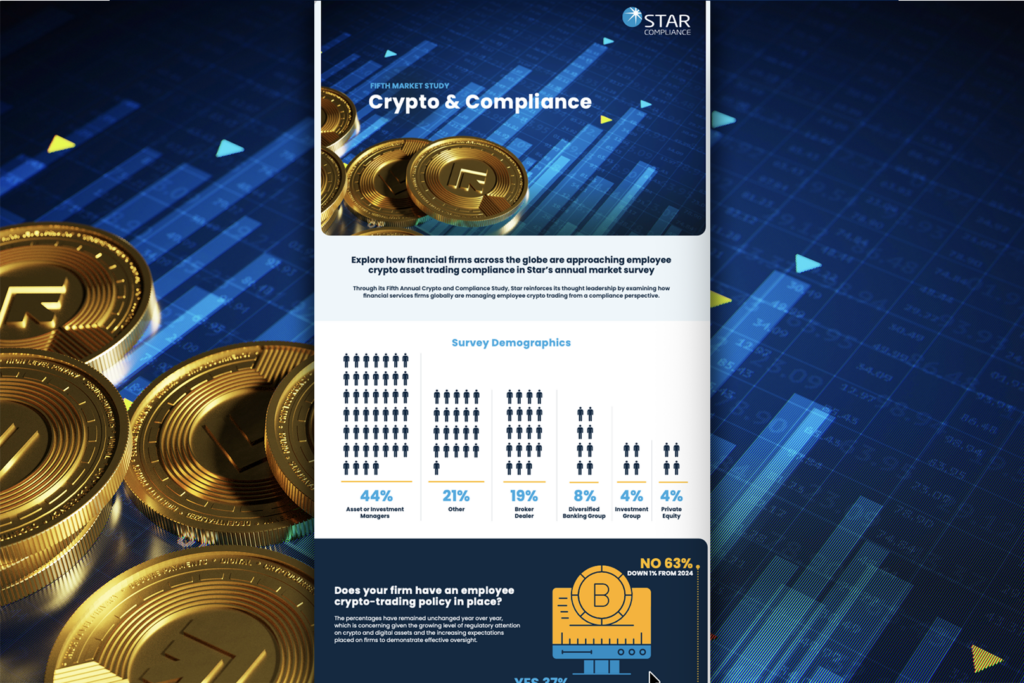
Fifth Annual Crypto & Compliance Study