Insider Trading Management Software vs. Spreadsheets: What It Actually Costs to Switch
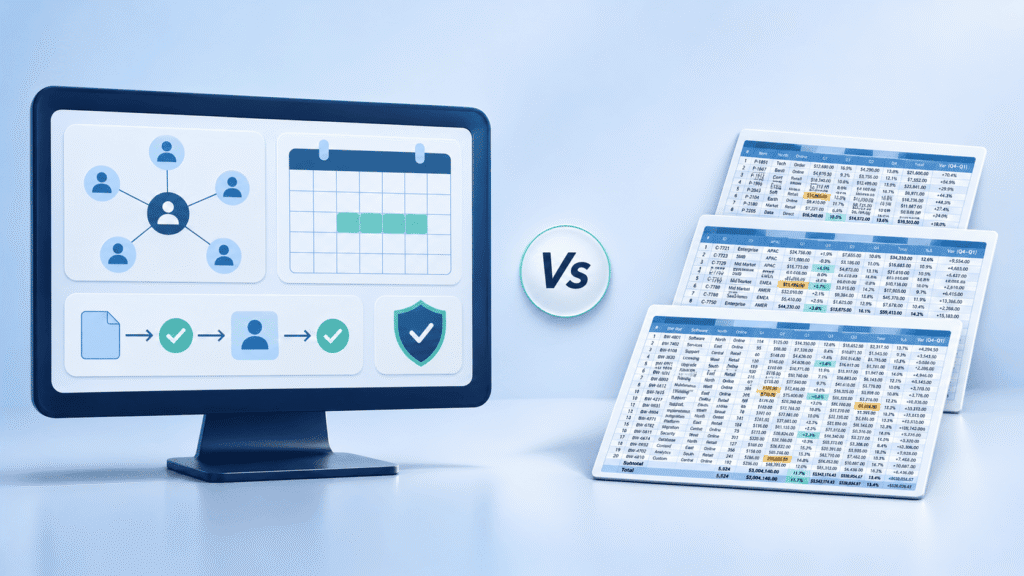
Most compliance teams that still manage insider lists and MNPI tracking in spreadsheets have asked the same question at some point: What will it cost us to move to dedicated software? Licensing, implementation, data migration, and training all come to mind quickly.
That question covers only half the math. Spreadsheets carry costs of their own, and those costs grow every year in staff time, audit gaps, and regulatory exposure. A fair evaluation of insider list management software weighs the cost of switching against the cost of staying put.
This guide breaks down both sides, so CCOs and compliance managers can make the call with a clear view of the trade-offs.
The Hidden Costs of Staying on Spreadsheets
Spreadsheets feel free because the firm already owns them. Their real costs show up in other places.
The Swivel Chair Problem
When MNPI tracking lives across spreadsheets, email threads, and separate systems, compliance staff spend their days moving between them to piece together who knows what. StarCompliance calls this the “swivel chair” approach, which makes it difficult to see clearly what information employees hold. Every update has to be entered, checked, and reconciled by hand.
Dedicated software replaces that patchwork with a single source of truth for MNPI-related activity, so insider lists, watch lists, restricted lists, and wall crossings all sit in one place.
Version Control and Audit Trail Gaps
Spreadsheets can get copied, emailed, and edited by multiple people, which means over time, teams can end up with conflicting versions and no reliable record of who changed what, or when.
That becomes a serious problem when a regulator or issuer asks for an insider list. Under the EU and UK Market Abuse Regulation, insider lists must show each person with access to inside information, why they were added, and the date and time they gained access. A spreadsheet with an unclear edit history is hard to defend under examination.
Time That Does Not Scale
Manual tracking can work for a small team. As headcount, deal flow, and trade volume grow, the workload grows with them: adding and removing insiders, notifying employees, checking trades against lists, and chasing missing information. Compliance teams end up spending more hours on data upkeep and fewer on the judgment calls that need their expertise.
Risk Exposure
The largest cost of continuing to use spreadsheets never appears on a budget line. Manual processes make it easier to miss a flag, apply pre-clearance rules inconsistently, or leave a former deal team member on a list. Each of those gaps can turn into an exam finding or, worse, an undetected insider trading issue.
The Real Costs of Switching
Moving to insider trading management software does take investment. Planning for those costs up front helps keep the project on schedule.
Implementation and Onboarding
Every firm needs time to configure workflows, set up rules, and connect existing systems. The timeline depends on firm size, the number of integrations, and the complexity of the firm’s policies.
Data Migration
Current insider lists, project records, restricted lists, and employee data all need to move into the new platform with their original dates intact. Teams should set aside time to clean up spreadsheet data before migration, since inconsistencies tend to surface during the move.
Training
Compliance staff need to learn the new system, and employees need to know how to submit pre-clearance requests and respond to notifications. An intuitive interface and single sign-on make that adjustment easier for everyone.
Change Management
Switching affects more teams than compliance alone. HR supplies employee data, IT handles authentication and integrations, and legal weighs in on policy. Bringing those groups in early helps keep the transition smooth.
Star built its platform to lighten that load. StarCompliance supports IT teams with easy implementation and seamless migration, and the STAR Platform can integrate with deal management, order management, HR, and research tools to pull in firm data automatically.
| Staying with Spreadsheets | Switching to Software | |
| Upfront Cost | No new licensing | Licensing, implementation, and onboarding |
| Staff Time | Manual entry and follow-ups that grow with headcount | Automated workflows, notifications, and pre-clearance |
| Data Accuracy | Conflicting versions and manual errors | Single source of truth |
| Audit Trail | Incomplete and hard to trace | Timestamped record of every action |
| Exam Readiness | Records rebuilt by hand on request | Insider lists and reports available on demand |
| Risk Exposure | Missed flags and inconsistent enforcement | Rules applied consistently to every request |
| Scalability | Strains as headcount and trade volume grow | Scales with the firm through cloud-based software |
| Learning Curve | Familiar to the team | Training needed for compliance staff and employees |
See How Star Handles Migration & Onboarding
Curious what switching would look like for your team? See how StarCompliance handles migration and onboarding with a personalized walkthrough.
Frequently Asked Questions
How long does it take to implement insider trading management software?
Implementation time for insider trading management software depends on firm size, the number of systems being connected, and how much workflow configuration the firm needs. Firms moving away from spreadsheets should ask vendors for a project plan that covers configuration, data migration, testing, and training, so every stakeholder knows what to expect before work begins.
What data needs to migrate when switching insider list platforms?
When switching insider list platforms, firms typically migrate current and historical insider lists, project or deal records, employee and third-party contact details, and watch or restricted list entries. Regulators can request historical insider lists, so firms should confirm that every record arrives complete, with the original dates and times of access intact.
Is insider trading management software hard to set up for IT teams?
Insider trading management software is generally manageable for IT teams to set up when the platform is cloud-based. A SaaS platform removes the need to host and maintain servers in-house, and single sign-on simplifies employee access. IT involvement usually centers on authentication, data feeds, and integrations with the firm’s existing systems.
Can insider trading software integrate with existing HR or trading systems?
Yes, insider trading software can integrate with existing HR and trading systems. The STAR Platform connects with deal management, order management, human resources, and research tools, so employee and trading data flows in automatically. That reduces duplicate data entry and keeps insider lists aligned with current staff and deal activity.